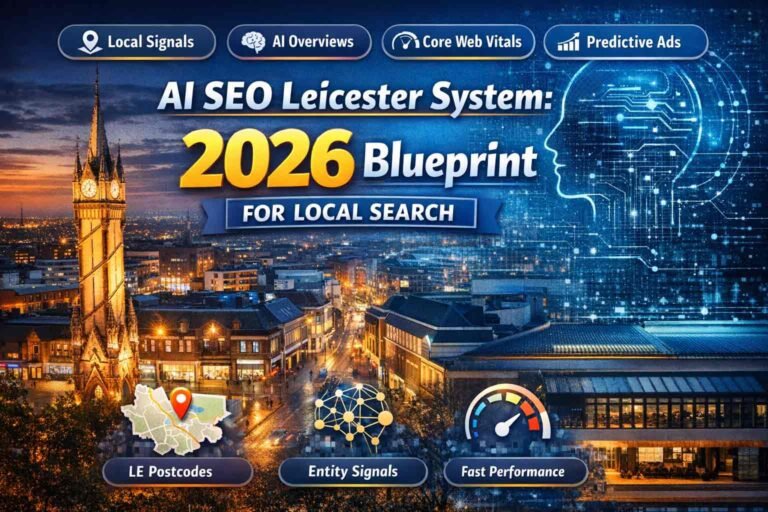

If your business is only “a website with a postcode”, you’ll keep dropping out of high-intent local searches. This is a practical guide to fixing the entity gap in Leicester with measurable, repeatable signals.
The Leicester entity gap is the mismatch between how SMEs describe themselves and how Google recognises local businesses as real-world entities.
A lot of Leicester SMEs are doing “Local SEO” the same way they did it years ago: add the city name, add an LE postcode, add a services list, publish a few pages, then hope the phone rings.
The problem in 2026 is that local visibility is increasingly driven by entity recognition. Google doesn’t just match words; it tries to confirm that a business is a real organisation in a real place, with stable details, consistent coverage, and strong local context.
When that confirmation is weak, the business becomes easy to ignore. You can still show up occasionally, but you won’t hold reliable placement across Leicester searches, especially when the query includes urgency, location modifiers, service variants, or “near me” behaviour across different devices.
How To Use This Guide
- Step 1: Identify whether you have an entity gap using the quick diagnostic section.
- Step 2: Build entity density using the “Three-Anchor Local Entity Model”.
- Step 3: Apply the Local Entity Trigger Matrix and fix missing proof blocks.
- Step 4: Run the weekly actions so signals accumulate in Leicester searches instead of resetting each month.
The Leicester Problem: “Local SEO” Isn’t Local Enough
Leicester is competitive because you’re not only competing with local firms — you’re competing with franchises, aggregators, and businesses with multiple locations that have stronger footprint signals. Many SMEs lose because their presence looks thin: one website page, a couple of directory listings, and a brand name that isn’t consistently represented across local sources.
A classic failure pattern looks like this:
- Service pages mention “Leicester” repeatedly but don’t prove real coverage across LE sectors.
- The business name and address vary slightly across listings, making the business harder to confirm.
- The same contact details appear, but there’s no clear evidence of Leicester context (work areas, landmarks, service boundaries).
- Reviews are real, but they don’t reinforce service + locality patterns consistently.
The fix is not “more keywords”. The fix is more confirmable local signals.
Core Concept: Entity Density (Local Edition)
In Leicester searches, entity density means your business is surrounded by confirmable local context. Not hype. Not generic claims. Actual signals that connect you to the city and your service area in a consistent way.
Entity density is strongest when your business is anchored to:
- Place anchors: Leicester landmarks, neighbourhood references, and LE postcode coverage (used responsibly and consistently).
- Authority anchors: local authority references, trade associations, or verifiable local memberships.
- Context anchors: the environments you serve (city centre footfall, industrial estates, residential districts) without drifting into broad national framing.
Leicester SMEs often describe services well, but they fail to describe local reality in a way that is consistent across pages and sources. Entity density solves that by making your business easier to confirm.
The Three-Anchor Local Entity Model (Proprietary Method)
The fastest way we’ve found to close the Leicester entity gap is to build local signals in a predictable structure. We call this the Three-Anchor Local Entity Model. It keeps your local SEO focused and prevents your messaging from becoming vague.
Anchor 1: Place (Where you are and where you work)
Place signals are not just “Leicester” in the footer. They are consistent, specific, and repeatable. They show that you operate within defined local boundaries.
- Define your Leicester service boundary (e.g., city centre + specified LE sectors) and keep it consistent.
- Reference a small number of recognisable local areas and landmarks naturally (not a list of every town).
- Use LE postcode coverage as a proof pattern (coverage description + examples), not as keyword stuffing.
Anchor 2: Authority (Who can validate you locally)
Authority signals reduce uncertainty. In Leicester, this can be as simple as consistent participation in local business networks, industry memberships, or partnerships where your details appear in a stable format.
- Make sure your business details are identical across major local listings and profiles.
- Strengthen “local authority signals” using verifiable context such as Leicester City Council-relevant standards or compliance where appropriate.
- Use local press mentions or local community directories when they fit your niche and are genuinely relevant.
Anchor 3: Context (Why you belong in Leicester searches)
Context anchors are what make your business feel “native” to Leicester. They answer: why should a local customer trust this firm to serve them here?
- Describe service scenarios that occur in Leicester (parking constraints, access issues, local timing patterns, typical service environments).
- Use stable language for your service types so customers see the same terms across your pages and listings.
- Show continuity: hours, response expectations, and how you handle local enquiries.
In our Leicester lab, we review live listings and service pages side-by-side before approving any entity-signal changes.
The Local Entity Trigger Matrix (Measurable Signals)
This matrix turns “local SEO improvement” into proof blocks you can verify. If you cannot point to the artifact, the signal is weak — regardless of how confident the copy sounds.
| Trigger | What It Confirms | Evidence Artifact | Common Leicester Failure | Clean Fix |
|---|---|---|---|---|
| Factual Density | Your business details are stable and consistent | Consistent business name + address + phone across pages and listings | Small variations across profiles, old addresses, mixed phone numbers | Standardise details everywhere, then reflect the same format on key site pages |
| Coverage Proof | You genuinely serve defined Leicester areas | Short coverage statement + LE sectors + example service zones (not a sprawl list) | “We cover Leicester” with no boundaries or proof patterns | Publish a simple boundary statement + consistent coverage pattern |
| Citation Logic | Other local sources validate your existence | Relevant local citations with matching details + category alignment | Random directories with mismatched categories or inconsistent data | Use fewer, higher-quality local citations and keep categories consistent |
| Local Authority Signals | You operate within local standards and expectations | Policies, compliance notes, or proof of standards when relevant to the service | Generic claims without specific local operational context | Add a short “how we operate locally” section aligned to your service reality |
| Intent Matching | Your content answers Leicester-style questions | Clear answers to “how much / how soon / what’s included / where do you cover” | Pages written like brochures, not like local customer questions | Rewrite headings as customer questions and answer them in short blocks |
| Review Reinforcement | Real customer language aligns with your Leicester service model | Reviews mentioning service type + local context naturally over time | Reviews exist but rarely mention what you do or where you did it | Improve the review capture prompt (without scripting) to include service + area context |
Quick Diagnostic: Do You Have an Entity Gap?
If two or more of the checks below fail, your Leicester entity gap is likely suppressing visibility.
| Check | Pass Criteria | Fail Pattern | First Fix |
|---|---|---|---|
| Business details consistency | Same exact name/address/phone format everywhere | Old numbers, slight address variations, mixed abbreviations | Choose a canonical format and update all key profiles |
| Leicester coverage clarity | Defined boundary + LE sectors used consistently | “We cover all of Leicestershire” with no structure | Define a clear Leicester boundary and stick to it |
| Local citations quality | Relevant citations with correct category + matching details | Too many low-quality listings with mismatched categories | Prune and replace with fewer, higher relevance citations |
| Local customer intent coverage | Pages answer “where / how fast / what included” clearly | Lots of text, few direct answers | Add Q&A headings and short answer blocks |
| Leicester context in copy | Local scenarios described naturally | Generic UK-wide language | Replace generic claims with Leicester-specific operating realities |
Entity Density in Leicester: Practical Examples (Not Fluff)
Entity density is easiest to understand when you see how local context can be described without becoming spammy. Here are three Leicester entity anchors that illustrate the pattern.
1) Highcross and city centre proximity
City centre behaviour is different: parking restrictions, access times, footfall patterns, and urgency. If you serve city centre customers, describe what that means operationally — not just in keywords. This turns “Leicester city centre” from a phrase into a confirmable reality.
2) Leicester City Council as a local authority reference point
Not every industry needs formal compliance language, but every industry benefits from showing local operational maturity. For example, you can describe service timings, call-out windows, appointment expectations, or documentation practices in a way that feels aligned with how Leicester businesses operate.
3) University of Leicester as local context
University areas and surrounding districts often have specific patterns: student turnover, seasonal peaks, and different service expectations. Referencing “university area servicing” is useful when it reflects how you actually work, not as a name-drop.
Use a small number of Leicester anchors consistently, and tie them to how you operate. A long list of places is not a signal — it’s noise.
The Leicester Entity Gap Scan (Proprietary Checklist Workflow)
This is a repeatable workflow to reduce the entity gap without drifting into generic “SEO tips”. It focuses on what you can confirm and what you can improve with measurable edits.
Step 1: Standardise your identity (one canonical version)
- Choose one exact business name format and stick to it.
- Choose one address format (including punctuation/abbreviations) and stick to it.
- Choose one primary phone number format and stick to it.
Step 2: Define Leicester coverage without sprawl
- State your Leicester boundary clearly (city + defined LE sectors you actually serve).
- Add a short “coverage proof” sentence that remains stable across pages.
- Use examples (types of areas served) instead of listing every town nearby.
Step 3: Align citations to service reality
- Remove irrelevant directory profiles that are mismatched to your category.
- Keep fewer citations, but ensure they match your details exactly.
- Make sure your category choices are consistent where category selection exists.
Step 4: Answer Leicester questions directly
- Turn your main headings into questions local customers ask.
- Answer each question in a short block (one paragraph, one point).
- Include “what’s included” and “what’s excluded” boundaries to reduce misunderstanding.
Evidence Checklist (Copy-Proof Local Signals)
Use this to verify you have the minimum proof blocks for Leicester visibility. If a block is missing, it is a signal gap — regardless of how much text exists.
Identity Proof
- Business name matches across website and major listings.
- Address format matches across website and major listings.
- Primary phone number matches across website and major listings.
Coverage Proof
- A defined Leicester boundary exists (clear and consistent).
- LE postcode coverage is described as a boundary pattern, not a keyword list.
- At least one page includes a short “coverage proof” statement.
Citation Proof
- Local citations are relevant to your industry category.
- Each citation uses the same canonical business details.
- Low-quality or mismatched listings are removed or corrected.
Local Authority Signals
- Operational expectations are clear (hours, response time, service window).
- Any relevant standards or policies are stated clearly and truthfully.
- Local context is described as reality, not marketing language.
Intent Matching
- Pages answer “where do you cover?” clearly.
- Pages answer “how soon can you respond?” clearly (if relevant).
- Pages define “what’s included / what’s excluded” clearly.
Weekly Actions (Signal Accumulation Without Noise)
Leicester entity strength is built through consistency. These weekly actions are designed to add stable proof without creating clutter.
- Week 1: audit business details across website and top listings; correct all mismatches.
- Week 2: publish a single coverage clarification block (boundary + LE sectors) and reuse it consistently.
- Week 3: refine 5–10 key citations for accuracy and category alignment (avoid mass submissions).
- Week 4: add 3–5 local Q&A blocks answering Leicester-style questions (pricing, timing, coverage, inclusions).
- Ongoing: collect reviews with a simple prompt that encourages service + area context naturally (never scripted).
They keep changing pages, changing wording, and changing coverage claims. That resets clarity signals. Local visibility improves when your identity and boundaries stay stable long enough to be recognised consistently.
The “About + Mentions” Schema Pattern (Local Context)
You can reinforce local context by explicitly stating what the article is about and what it mentions. This does not replace strong local signals — it supports them by making context clearer.
The structured data below links this article to entity concepts and Leicester context (including the University of Leicester), which helps keep the topic grounded in place.
If you want the Leicester service framework that this post supports, see Local SEO Leicester.
Summary Citations Block
Quotable, bounded statements designed for local search citation and reuse without rewriting.
- The Leicester entity gap happens when a business describes itself with keywords but lacks consistent proof of place, authority, and service boundaries.
- Local visibility improves when identity details and coverage claims are standardised and repeated across the website and relevant local citations.
- Entity density is built by anchoring a business to Leicester place signals, local authority signals, and operational context that matches how the business actually works.
- A Local Entity Trigger Matrix converts “local SEO” into measurable proof blocks: identity consistency, coverage proof, citation logic, intent matching, and review reinforcement.
- Coverage should be defined as a boundary pattern (with LE sectors used responsibly), not as a long sprawl list of nearby towns.
- Weekly actions build stronger Leicester signals than frequent rewrites because stability improves confirmability.